
Perched high in the Himalayas, Lukla Airport — officially known as Tenzing-Hilary Airport — is widely regarded as the world's most dangerous airport. Located in Nepal's Khumbu Pasanglhamu region near Mount Everest, it serves as a critical gateway for trekkers beginning their journey to the world's highest peak.
Despite its reputation for danger, Lukla Airport plays an essential role in connecting the region. With limited road infrastructure, it remains the primary lifeline for transportation, linking the remote town of Lukla to larger cities like Kathmandu and more accessible villages such as Manthali. While the flights most often carry tourists, hikers, and villagers, they also carry important goods such as building materials and cargo.
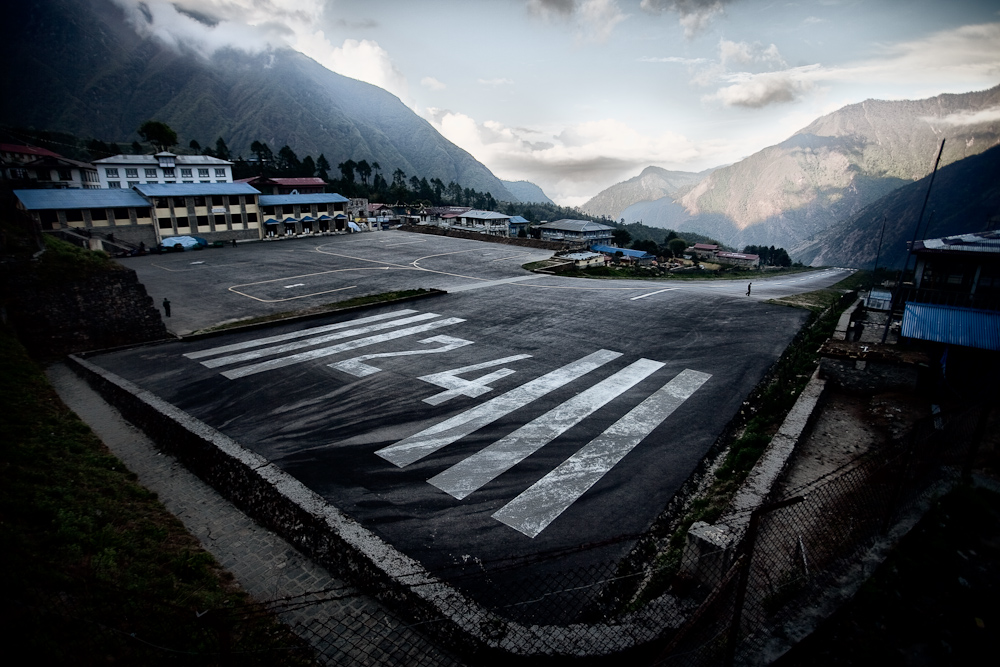
In the Mountains
At first glance, Lukla Airport looks perilous, with nearby mountains making the approach exceptionally difficult. Built in 1964 under the supervision of Sir Edmund Hillary, the airport has grown to serve as a crucial connection point in the region. In 2008, the airport was renamed in honor of Hillary and Sherpa Tenzing Norgay, officially changing the name to Tenzing-Hillary Airport. However, many still refer to the airport as Lukla Airport. Despite its small size, the airport is quite busy, serving 129,508 passengers in 2019.
Lukla Airport's only runway (06/24) is 1,729ft (527m) long and 98ft (30m) wide. In comparison, the shortest runway at LAX is 8,926ft (2,721m) long, more than five times the size. This size limits the type of aircraft that can operate at the airport to those that have Short Takeoff and Landing (STOL) capabilities: the De Havilland Canada DHC-6 Twin Otter, Dornier 228, L-410 Turbolet, and Pilatus PC-6 Turbo Porter, to name a few.
In 2001, Lukla Airport's dirt-and-grass landing strip was paved with asphalt, improving safety for arriving and departing aircraft.

Unlock the full story.
Subscribe to keep reading, or read for free with ads (metered).
Learn More or Log in
Comments (0)
Add Your Comment
Recommended Articles
-
 How AI Quietly Became the Backbone of Today’s Aviation Industry
-
 The Shape of Disaster: The Plane That Kept Falling Apart Mid-Air
-
 Only Way Out: Private Aviation in a Region at War
-
 Analysis: How Spirit Airlines Changed Airline Pricing, then Paid the Price
-
 The Cockpit’s Next Revolution: When the Co-Pilot Is a Computer