
In an age where building just one airplane or helicopter reaches millions of dollars, manufacturers are always interested in reducing costs and expediting production without diminishing performance. A big driving force in this area is the continuing adoption of composite materials across more and more parts, as engineering teams continually look to reduce the overall weight of new aircraft designs.
A new process is in the early stages of development for applying metal leading-edge guards to carbon fiber-filled rotary blades, and it could dramatically lower costs while also significantly reducing manufacturing times.
Alpha Metalcraft Group, a manufacturer of products used for aerospace and defense industries, is working with several composite engineering firms to revamp the process of applying these leading-edge guards to composite-based propeller blades, with a specific aim to address what is forecasted to be explosive growth in market segments such as eVTOL aircraft.

Dr. Luigi Cazzaniga, AMG’s Director of Engineering, will present information about this proposed new manufacturing approach at CAMX, the Composites and Advanced Materials Expo. The expo will run from Sept. 21-24 in Atlanta.
Leading-edge guards are critical to the performance of rotor blades. Composite blades are subject to abrasion from weather, sand, dirt, and other elements. Metal leading-edge guards protect the blade and extend the service life.
While there are established application methods for attaching these separately manufactured metal guards to composite blades, the process involves extensive labor, inspection, and shipping costs. In addition, the current standard manufacturing process requires the use of expensive stainless-steel tools (mandrels) that exactly duplicate the shape of the rotor blade, with investment costs reaching up to $100,000 per tool.
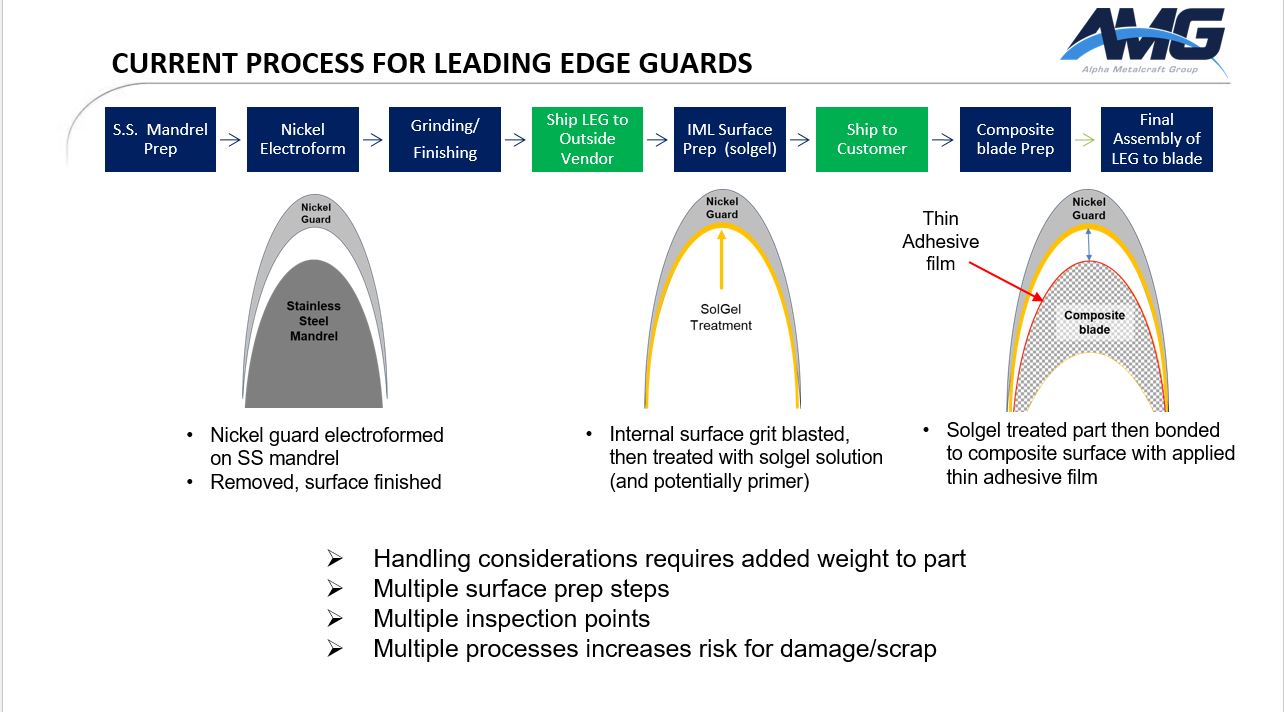
AMG is looking to develop a different approach and is working in cooperation with aerospace suppliers in the design of a novel composite blade that would allow for direct nickel deposition. “The ability to directly plate a nickel substrate onto a carbon-filled composite structure eliminates the need for multiple assembly processes and can lower overall manufacturing costs,’’ according to Dr. Cazzaniga.
Dr. Cazzaniga explains that carbon fiber-filled composite rotary blades offer significant benefits for the aerospace industry. Composite assemblies provide a path to lighter-weight parts that maintain structural performance, demonstrate improved durability, and allow for complex designs to reduce noise and vibration.
However, composite blades lack sufficient abrasion resistance, which can lead to excessive damage and premature failure of the part. Blades are susceptible to environmental degradation caused by sandy environments, salty coastal air, and even lightning strikes.
The leading-edge guards are manufactured via electroforming, a chemical process that is comparable to 3D printing but unique in that it offers considerable flexibility in addressing different geometries and mechanical property requirements. “It’s critical to manage tight tolerances, overall part weight, tensile properties and abrasion resistance,’’ Dr. Cazzaniga said.
The electroforming process is slow — just a few thousandths of an inch per hour per square foot — but can occur off-hours and does not require employees to continually monitor the process. The mandrel is set into a solution and left overnight. By scaling up the size of tanks, electroforming also offers the capability of large production runs.
After additional finishing to meet the tight profile and thickness tolerances required by aerospace customers, the abrasion guards are shipped out to third-party vendors for surface preparation prior to being delivered to the composite vendor for final assembly to the rotary blade.
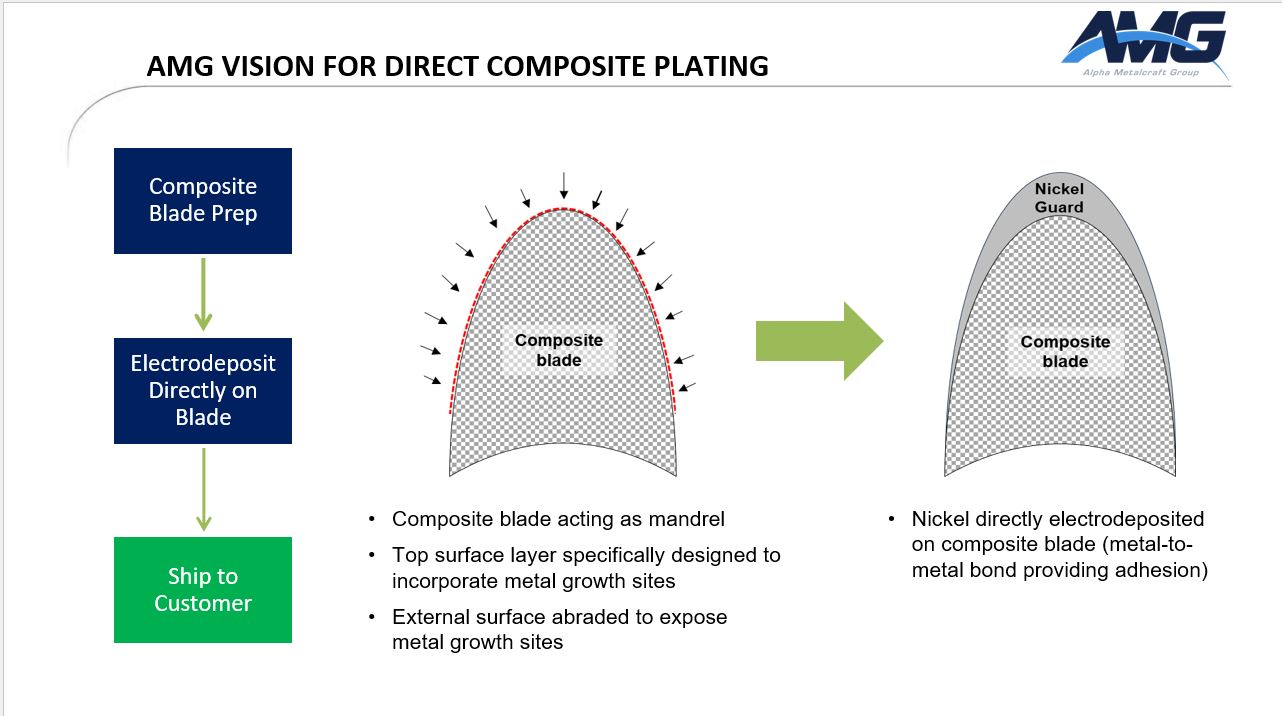
Direct composite plating sidesteps many of these individual process steps by using the composite blade itself as the electrodeposition tool or mandrel. “Direct composite plating on a composite part takes the weight distribution/reduction benefit of electroforming even further, as the leading can still be made very thick, where most of the abrasion takes place, but the handling restrictions on the trailing edge are removed so these can be made even thinner, reducing the overall weight of the part further”, explains Dr. Cazzaniga, “The additional weight savings, as well as elimination of multiple assembly processes, will provide significant cost savings.”
One of the primary challenges AMG found in developing the process centered on the adhesion of the guards to the propeller. There are a variety of techniques for plating on plastics, primarily targeting appearance, corrosion shielding, lightning, and electromagnetic interference (EMI) shielding. These multi-step processes are complicated, involve hazardous chemistry, are costly, and are primarily suited for large-scale production of smaller components. AMG has been focusing on concerns with adhesion when the process is transferred to heavy components, such as abrasion guards weighing up to several pounds.
“Rather than work from the perspective of trying to modify existing composite structures to accommodate an electroplating process solution, we have focused on working with aerospace suppliers in the design of an electroplating-ready composite blade that would allow for direct nickel deposition, provide excellent adhesion and significantly reduce both the time and cost to manufacture ready-to-assemble propeller blade designs,’’ Dr. Cazzaniga said.
AMG’s direct composite plating process will require certification to achieve full-scale production. Developing this process in parallel to the adoption of a standard leading-edge guard strategy could be extremely beneficial to support the eVTOL market, which is expected to scale significantly in the next decade. Industry experts project the market could reach $41.8 billion between 2030 and 2034, with each individual aircraft requiring 30-50 individual propeller blades.
“Direct deposition of nickel abrasion guards onto carbon-filled composite blade structures represents an exciting advancement in the field of materials engineering and rotary blade design,’’ Dr. Cazzaniga said. “The ability to directly plate a nickel substrate onto a carbon-filled composite structure eliminates the need for multiple assembly processes and can lower overall manufacturing costs, while still ensuring proper adhesion of the nickel abrasion guard to the composite surface. Future work will focus on optimizing electrodeposition parameters and exploring the scalability of this technology for high-volume eVTOL blade manufacturing.”
Comments (0)
Add Your Comment
Recommended Articles
-
 How AI Quietly Became the Backbone of Today’s Aviation Industry
-
 The Shape of Disaster: The Plane That Kept Falling Apart Mid-Air
-
 Only Way Out: Private Aviation in a Region at War
-
 Analysis: How Spirit Airlines Changed Airline Pricing, then Paid the Price
-
 The Cockpit’s Next Revolution: When the Co-Pilot Is a Computer