

The date is July 4, 2025.
In the Hill Country region of Texas, a tropical storm has made landfall, causing unprecedented flooding. Six flash flood warnings have been issued, with the nearby Guadalupe River rising 26 feet in just 45 minutes. At least 100 people have lost their lives thus far.
A search and rescue team now operates in the aftermath of the flood. They are in a race against time.
At this point, the landscape has been swept away. Cell towers are gone. Fiber lines are severed. The team now relies on a LEO satellite link to coordinate movements. A camera-mounted drone flies overhead, piloted by the rescue team, searching for any signs of life.

But suddenly, the connection drops. The drone, now operating Beyond Visual Line of Sight (BVLOS), loses its command link. The live video freezes. The crew is unable to proceed.
This is the unfortunate reality of connectivity in modern-day mission-critical environments. The aerospace industry has seen rapid developments in autonomous drones and sensors, but the networks sustaining these devices are still years behind. Connectivity is treated as if it can be compromised, yet modern technologies assume that it is always available.
Thus, it is important that the focus begins to shift into delivering new connectivity solutions capable of supporting the pace at which their dependencies evolve. These solutions must be designed with a level of redundancy to support this connection continuity, even under conditions of failure. One company delivers a solution to this emerging dilemma through a multi-channel, "active-active" connectivity protocol that promises an unprecedented level of reliability for its consumers.
Why Connectivity is the Bottleneck
Modern LEO satellites can now provide lower latencies than ever, to parts of the world that were previously considered unreachable. However, they are plagued with lossy environments, proliferated by factors like intermittent performance, orbital congestion, and signal attenuation.
According to global network provider Contrivian, during Starlink LEO satellite handoffs – which occur in 15-90 second intervals – recorded latency spikes average up to 50ms. Considering a median peak-hour latency of 25.7ms, these perturbations can have a considerable impact on network performance, even if their effects only last for a fraction of a second.
Nowadays, these networks often use sophisticated software to mask instability from the end user. But under this mask lie the real symptoms of a hostile RF environment: packet loss and latency spikes. Especially in applications requiring real-time control or edge autonomy, even a brief spike in latency could prove detrimental to a system. In fact, research by Contrivian indicates that, while there exist congestion control algorithms to maximize throughput on LEO or GEO networks independently, there is no solution that can optimize well across multiple orbits simultaneously.

The legacy approach to network redundancy is based on primary and secondary connections, a mindset that stems from traditional telecommunications and circuit switching. Its premise is simple: a system operates on a primary path until it fails, after which it falls back onto a secondary path. In the case of satellite connectivity for communication, the primary path would represent a fiber or a specific satellite link. The secondary path would represent a Geosynchronous Orbiting (GEO) satellite or an LTE connection.
But this method is flawed. First, the transition from primary to secondary path is rarely seamless. When a failover occurs, the existing data stream is typically interrupted. And once control loops or VPNs are in play, the session is broken entirely, requiring a hard reset. And second, while fiber cuts are rare and only result in short-term down periods, LEO satellite disruptions are frequent and transient. Connections often stutter due to hand-offs or satellite interference, which is difficult to mitigate. A primary-secondary model, in this case, is simply unequipped to handle these rapid fluctuations.
A Shift to Continuous Connectivity
A new approach, led by Contrivian, is mitigating this instability through an "active-active" network architecture. This approach moves away from the standard primary-secondary model and toward simultaneous, multi-channel transmission. In an active-active model, data flows across multiple networks at once. An intelligent routing layer is placed above the physical transport, monitoring every available path in real-time.
This system can be likened to a singer using two microphones at once. In essence, they are recording twice; their voice is being transmitted to the end user – the listener – on the active channel, while the secondary channel also receives transmission, but remains muted. If any interruptions occur on the main line, the transmission is toggled immediately, resulting in a seamless musical experience from the listener's perspective. And, because this change occurs over a fraction of a second, the audience does not hear any pops, gaps, or volume fluctuations.
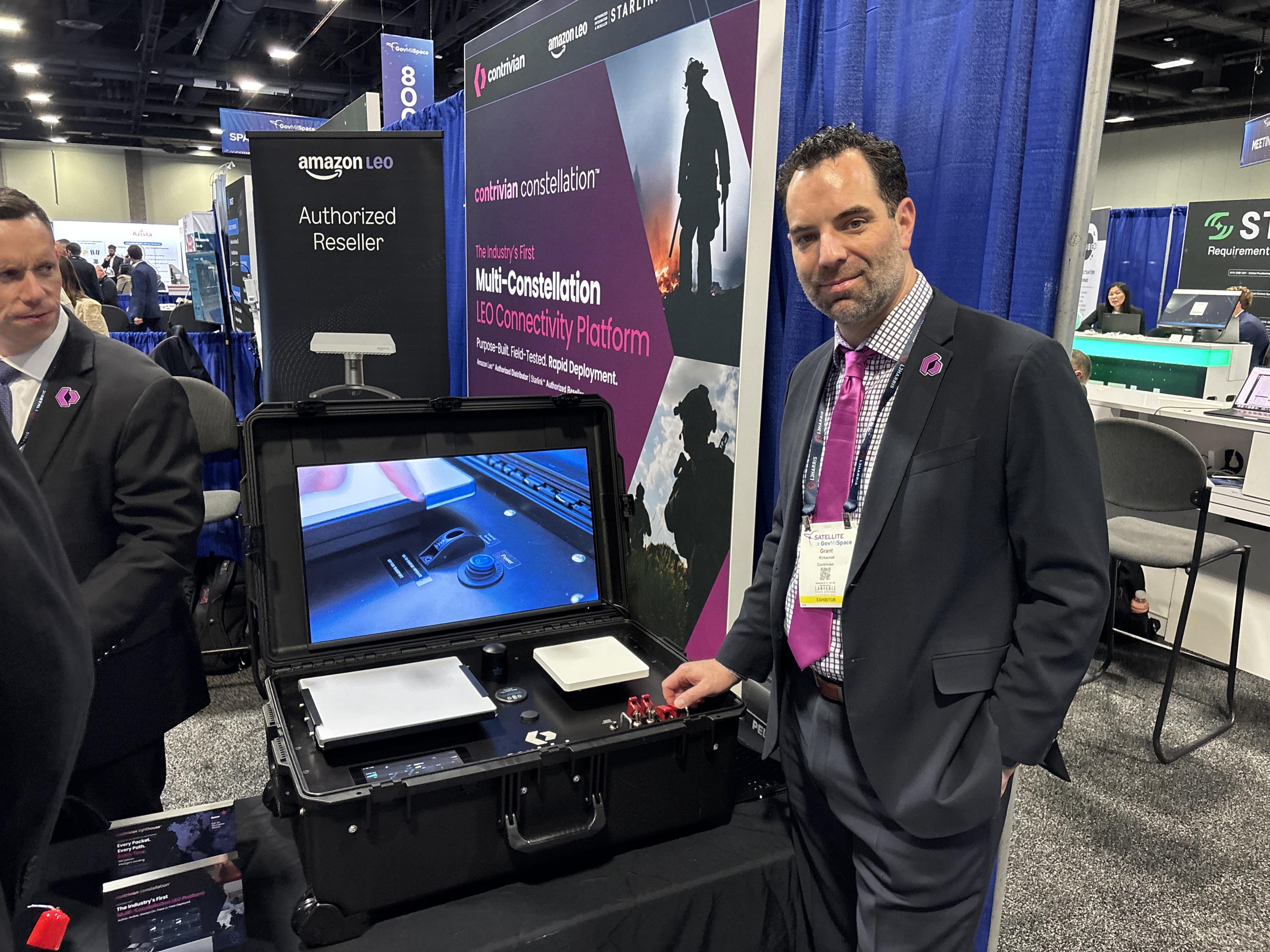
In conversation, Contrivian CEO Grant Kirkwood explained the logic behind this active-active approach, specifically the routing between the channels in real-time. "Around the world, we have these beacons – we call them lighthouses. The appliance we put on premise, behind Starlink and Amazon LEO, is pinging all those beacons to understand what its performance looks like. We create a tunnel [to each lighthouse] and combine them back together at the remote end, and we send the data across those paths in real time. So if one's going up or down, the other is taking over in about 200 milliseconds, so you don't even notice."
However, transmitting identical data packets through multiple streams simultaneously is computationally expensive, especially as more concurrent datalinks are established. Contrivian navigates this through a concept known as Packet Header Replication. In it, headers are sent through several channels at once, providing information such as packet length, IP addresses, and port numbers, with the payload being transmitted only through the channel considered "active." Kirkwood elaborates, "We're basically taking the stream of data and chopping it – but not in the middle. We're sending the headers on both, and the payload on the active one. So if the far end starts receiving headers but no payload, we know that the path failed, so it retransmits the payload on the other side."
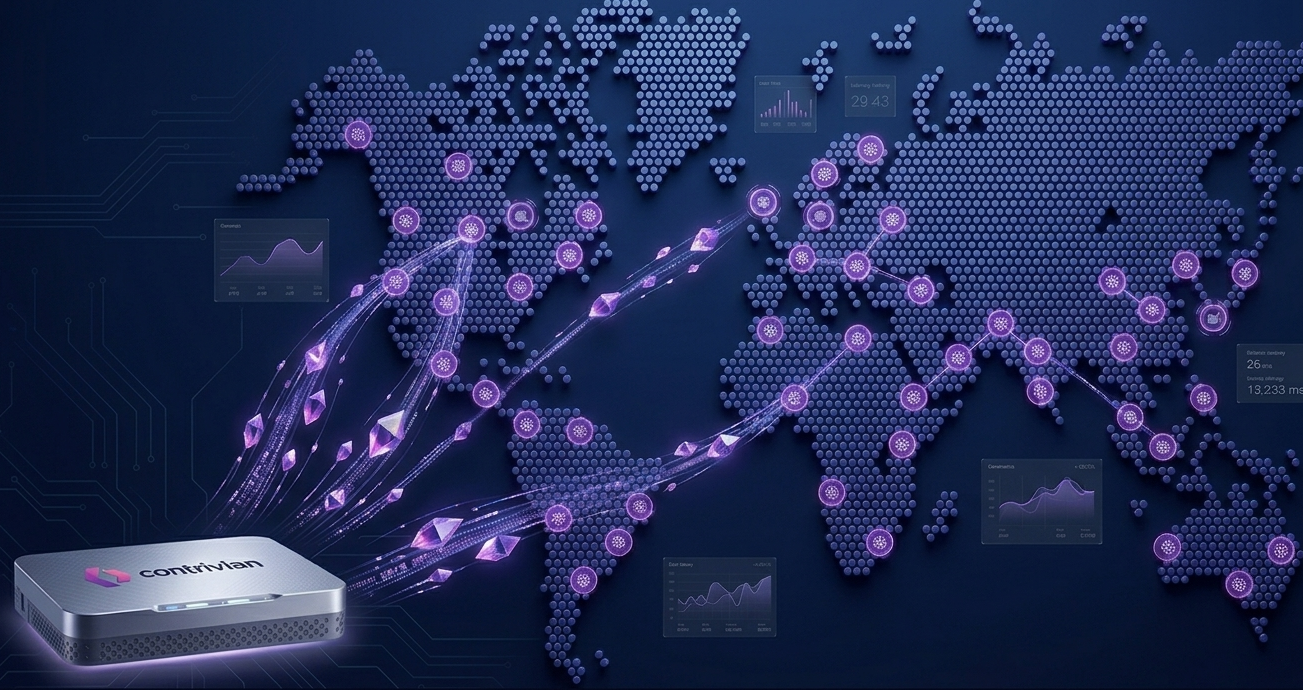
Thus, by treating multiple networks as a single, unified connectivity layer, engineers can achieve a level of session persistence that was previously only possible with dedicated terrestrial fiber.
Multi-Constellation LEO
Relying on a single satellite constellation introduces a single point of failure. Between factors such as outages, cyberattacks, and congestion, it is nearly impossible for a provider to guarantee 100 percent uptime.
Contrivian's breakthrough lies in multi-constellation LEO orchestration. Its software combines providers like Starlink, OneWeb, and Amazon LEO into a single, unified architecture, offering diversity in orbital paths to its clients. Thus, customers can now consume multiple satellite networks as one service with a single IP address and one data plan. What's more, TCP acceleration proxies are no longer necessary, and standard VPNs are now compatible off-the-shelf, without needing any additional modifications.
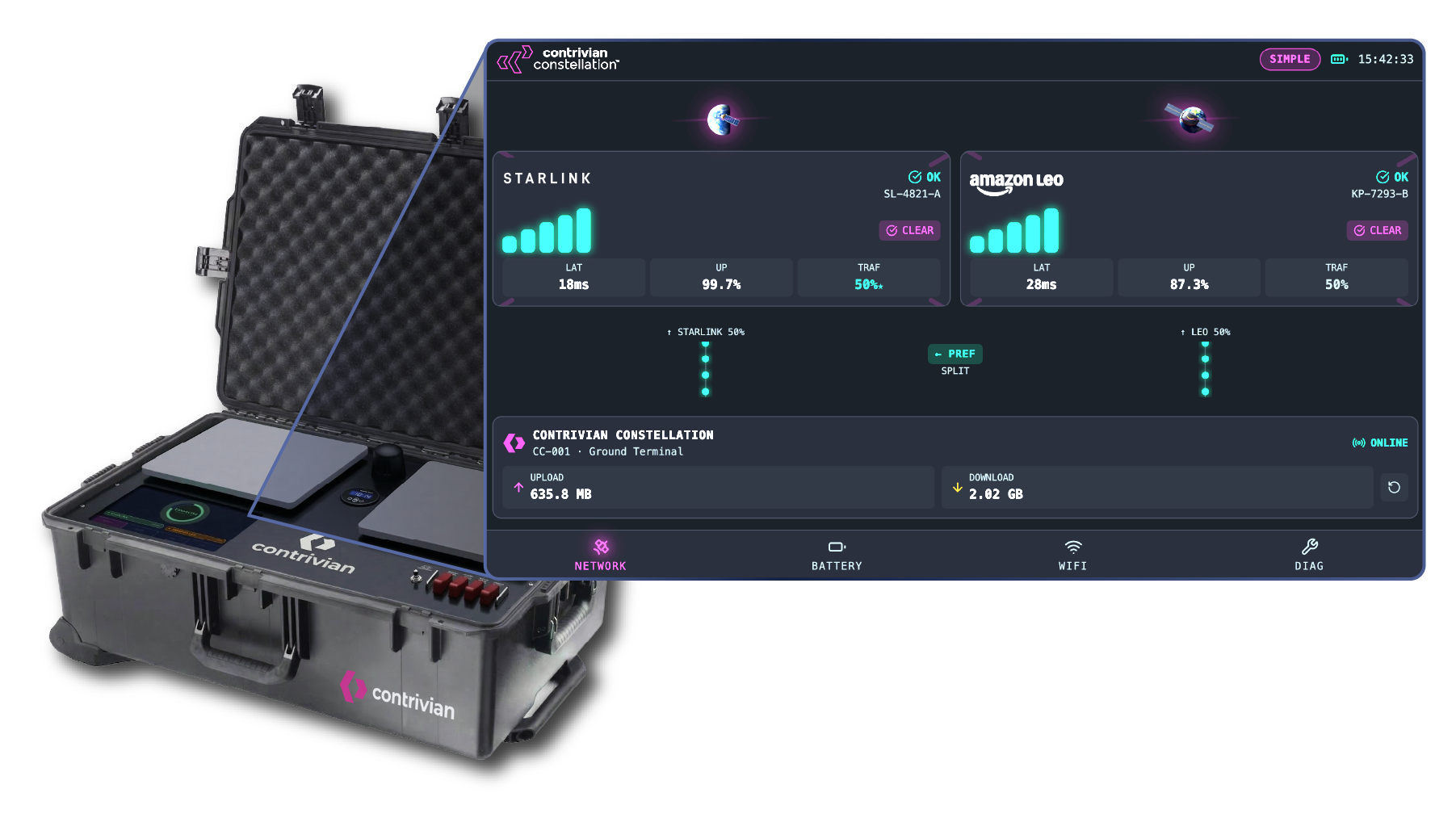
This model also provides an additional level of security against spoofing and cyber attacks. Contrivian leverages the various frequencies used by each constellation to provide failsafes in the case of interference. For example, Starlink and Amazon LEO utilize different parts of the Ku and Ka bands. If one frequency is targeted, the other likely remains clear. This intelligent modulation between various separate networks steers users away from trouble while maintaining an unprecedented level of reliability.
Implications for Autonomy and Aviation
This presents a pivotal shift for the aerospace sector, particularly within UAVs and uncrewed systems. Scalable BVLOS operations require a level of continuity that is immune to interruption by satellite handoffs or jamming. Contrivian's solution provides the ability to prioritize critical flight data over less important information like telemetry logs or secondary video feeds, enabling a hybrid approach to reliable remote operations.
With the increased pace of development in the field, the industry is in a position where advancements in connectivity drive – or hold back – the pace. Along with the rapid development of more powerful autonomous or sensor technologies, it is crucial that the network on which they operate offers a comparable level of reliability, especially considering its foundational role. In this new era, the complexity of this challenge is now hidden behind a software-defined layer that provides a stable, predictable experience.
Going forward, the systems that win will be the ones designed to operate through failure, instead of avoiding it altogether.
Comments (0)
Add Your Comment
Recommended Articles
-
 How AI Quietly Became the Backbone of Today’s Aviation Industry
-
 The Shape of Disaster: The Plane That Kept Falling Apart Mid-Air
-
 Only Way Out: Private Aviation in a Region at War
-
 Analysis: How Spirit Airlines Changed Airline Pricing, then Paid the Price
-
 The Cockpit’s Next Revolution: When the Co-Pilot Is a Computer