
The business jet has looked more or less the same for the past 50 years. A tube. Two wings. Engines at the back. It’s a formula that has worked, so why change it? Otto Aerospace has a reason.
The Phantom 3500, Otto’s newest project, is a fundamentally different aircraft, with its unique, eggplant-shaped fuselage and windowless cabin design. But Phantom’s biggest edge comes from its fuel efficiency.

The aircraft is designed around laminar flow, a principle that aerodynamicists have chased since the early days of aeronautical engineering. By maintaining smooth (laminar) flow over the wing, drag – and, subsequently, fuel burn – falls dramatically. For decades, this idea was theoretically sound but practically out of reach. Otto’s CEO Scott Drennan says the barriers have collapsed, pushing business aviation into a new era.
“When the Phantom 3500 enters service in 2031, I believe it will reset expectations for what efficiency can look like – first in the business jet category and then more broadly across aviation.”

But this new development has not come suddenly. The Phantom represents years of incremental innovations, spanning from aerospace design softwares to physical fabrication processes. Drennan shared, “Achieving laminar flow at the scale we will deliver has long been the holy grail of aerodynamic design. But it simply wasn’t possible in decades past.”
According to him, what unlocked this new era was the maturity of enabling technologies arriving at the same moment. Proprietary computational fluid dynamics algorithms, run on supercomputers operating continuously for two years, allowed the team to model and optimize laminar flow aerodynamics with a precision that did not exist previously.
A 777 on Four Wheels? Inside One Superfan’s Mission to Celebrate His Favorite Airline
Developments in advanced composite manufacturing followed, enabling the design to hold the tight surface tolerances that laminar flow demands, minimizing disturbances that could trip the airstream into turbulence. According to Drennan, “when you bring all of that together in a clean-sheet design, laminar flow becomes practical in a way it hasn’t been before.”
The Shape of the Future
The Phantom looks the part. Its silhouette is unmistakably different from the conventional business jet. For an industry that prefers conventional aesthetics to minimize risk, this could be a liability. But Drennan doesn’t see it that way.
“The early response has been very encouraging,” he told AeroXplorer. “People have seen the renderings and witnessed the full-size mockup at various shows this past year. The feedback has been overwhelmingly positive, which tells us the industry is open to something different – especially if the performance is there.”
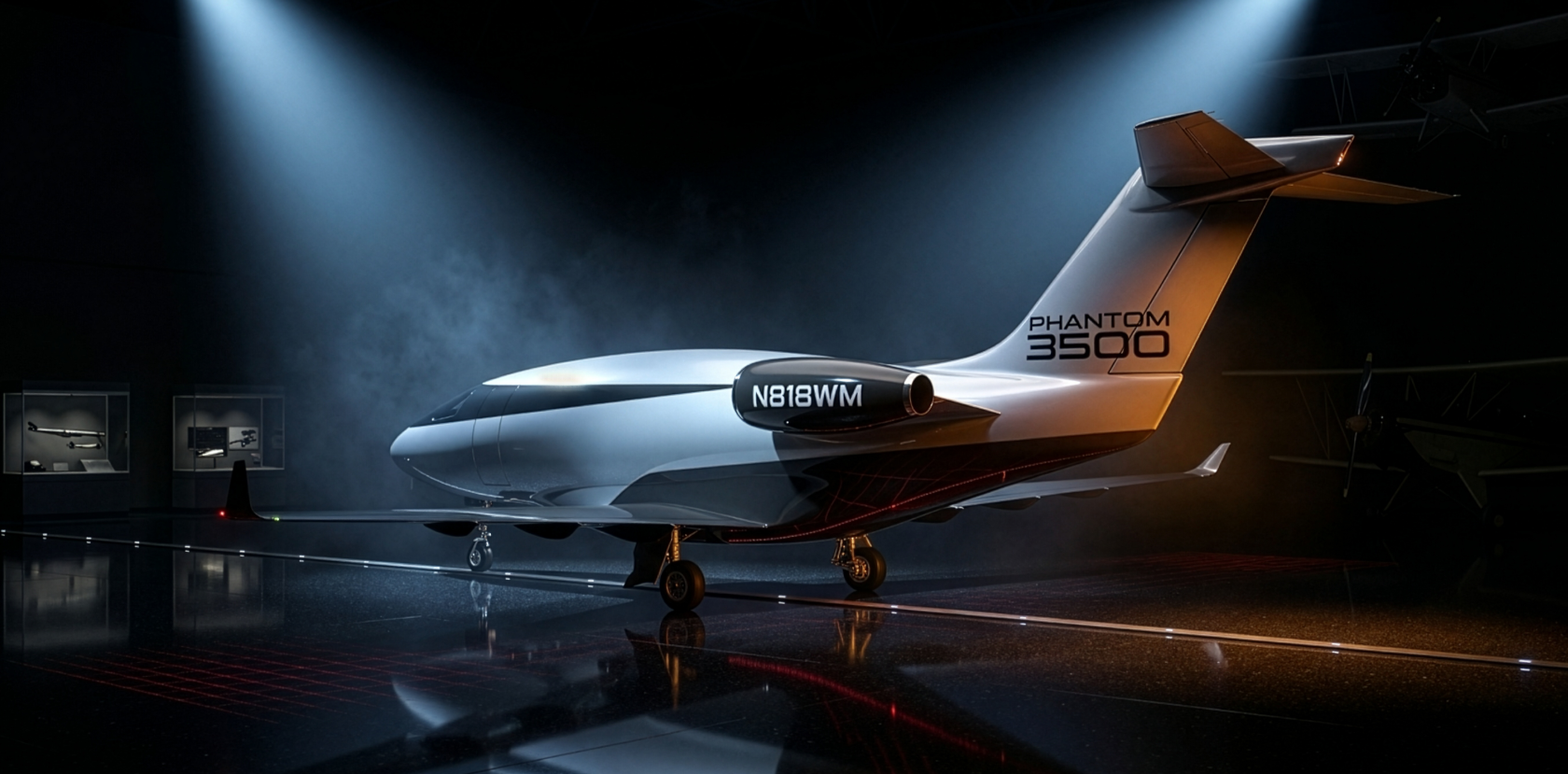
He frames the aircraft’s appearance as an asset, instead of a gamble, pointing to both the ramp presence and the passenger experience inside. On a webinar with AeroXplorer, he elaborated on ramp presence as a factor for passengers in selecting the Phantom: “I think it's important and we have a very unique design that's very aesthetically pleasing and can match the aesthetic of many of the customers out there.” The aircraft’s unconventional layout creates a roomier cabin than a traditional platform of comparable size, making the visual boldness functional as well.

Alaska Goes Global: How Hawaiian Airlines Changed the Carrier’s Future
Drennan put it plainly, “Aviation has always evolved when something clearly better comes along. We are clearly better.”
A Downstream Bet
But Otto’s long-term goals extend well beyond the business jet category. Drennan describes the Phantom as the beginning of a change that could influence future design decisions in applications ranging from commercial aviation to defense and autonomous aircraft. This will thus raise customers’ baseline expectations.
“Customers will expect better economics without giving up performance,” Drennen says, “and that will push the industry to rethink aircraft architecture from the outset.” According to him, “Once the industry sees that a new baseline is possible, it becomes much harder to justify going back.”
“I want Otto to be known as the catalyst that fundamentally changed the course of aviation history.”
– Drennan
Whether the Phantom delivers on that promise will be answered when it enters service in 2031. The pursuit of Laminar flow has always been a timing gamble, but Drennan believes the timing is now.
“When people look back in 10, 15, or 20 years,” he says, “I believe they will see the Phantom’s entry into service as the exact moment that everything changed.”
Comments (0)
Add Your Comment
Recommended Articles
-
 How AI Quietly Became the Backbone of Today’s Aviation Industry
-
 The Shape of Disaster: The Plane That Kept Falling Apart Mid-Air
-
 Only Way Out: Private Aviation in a Region at War
-
 Analysis: How Spirit Airlines Changed Airline Pricing, then Paid the Price
-
 The Cockpit’s Next Revolution: When the Co-Pilot Is a Computer