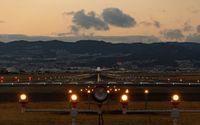
Kansai International Airport (KIX) is the primary international airport serving the city of Osaka in Japan. The airport opened on September 4th, 1994 to relieve increasing congestion at the existing Osaka Itami Airport (ITM). Although Kansai is located approximately 37 kilometers (22 miles) farther from the city, it handles a majority of the city's international traffic, while Itami now serves as the region's primary domestic airport. However, geological factors are increasingly putting Kansai Airport at risk of sinking, an unusual scenario related to how the airport was built.
Why KIX was Built
Discussions regarding the construction of a second airport in Osaka began in the 1960s. At the time, operations at Itami Airport were severely limited due to its proximity to the city. Noise from arriving and departing aircraft could be heard from the city center, resulting in a nighttime curfew that was imposed, which limited the hours that the airport could operate.

In an ideal world, one way to counteract limited airport operating hours would be to expand the airport so that it could serve more flights. Unfortunately, this was not an option for Itami Airport. Due to the airport's location, it was surrounded by residential development on all sides. Thus, there was no way to properly expand it such that its congestion issues could be resolved. With air traffic volumes continuing to increase in Japan — both on domestic and international fronts — Osaka needed a newer and larger airport to properly handle its growing demand.
Built on an Artificial Island
Construction on the new Kansai International Airport began in 1987. Due to space limitations, the airport was designed to be built entirely offshore on an artificial island measuring 4 kilometers long and 1.3 kilometers wide (2.5 miles long and 0.8 miles wide). The airport would be situated in Osaka Bay, which would offer passengers easy access to the city while providing ample space to accommodate busy airport operations.

Unlock the full story.
Subscribe to keep reading, or read for free with ads (metered).
Learn More or Log in
Comments (0)
Add Your Comment
Recommended Articles
-
 How AI Quietly Became the Backbone of Today’s Aviation Industry
-
 The Shape of Disaster: The Plane That Kept Falling Apart Mid-Air
-
 Only Way Out: Private Aviation in a Region at War
-
 Analysis: How Spirit Airlines Changed Airline Pricing, then Paid the Price
-
 The Cockpit’s Next Revolution: When the Co-Pilot Is a Computer